

|
|
|
Integrated Curriculum The Arts World Wide curriculum involves students in multiple assignments in a number of curricular areas. Therefore, the most promising pedagogical approach is to teach across the curriculum. It is highly recommended that, whenever feasible, the visual arts, social studies, and language arts teachers team teach the curriculum, with the educational technology specialist and librarian serving as key resource people. These instructors should plan and structure learning activities that call upon the students to access information from a variety of knowledge domains. Use of Community and Global Resources The curriculum should provide the students with access to a variety of both community and global resources. These might include study trips to local art museums, art in public spaces, and architecture. The Arts World Wide curriculum also will enable students to go on virtual field trips via the World Wide Web to sites such as The Louvre in Paris, The Museum of Modern Art in New York, the Philadelphia Museum of Art, and many other online art galleries. Collaborative Processing Model The process of creating, analyzing, and evaluating art that is recommended here is based on the collaborative processing model proposed by Neil Hauser (1991). The teacher should begin by exposing the students to a variety of media, styles, and techniques, which the students are then encouraged to explore and practice.
Next, the students will be encouraged to draw upon their own life experiences to begin plans for the creation of an artwork based on a ritual object or event that is personally meaningful to them. The student artists will then be given opportunities to share their preliminary ideas and sketches with a select group of peers in the class who can provide observations and reactions to these tentative plans. The student artists then will be encouraged to actively reflect on the peer feedback and make any modifications to their artworks they choose to make. During the final phase of this process, each student will select at least one work of art they have created for the entire class to observe. Then they will give a 10-minute oral presentation based on their artwork and accompanying paper. Next, a colleague in the class will give a brief oral critique of the artwork, followed by reactions and questions from the other students. The teacher can play an instrumental role by modeling the kinds of questions which lead to greater understanding and rendering insightful evaluative judgments. |
 Copyright 1995, 1998-2009
Eric Pals. All rights reserved.
Copyright 1995, 1998-2009
Eric Pals. All rights reserved.
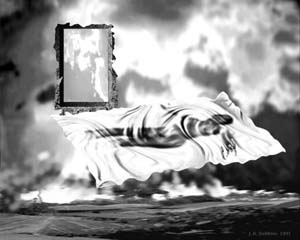
 John
Stebbins, African Dreams, 1995
John
Stebbins, African Dreams, 1995